Welcome to our first off-topic on-purpose post.
I think it’s feeling important to all of us to stay connected right now, and this is a place where we can do that. I’m still (as I’ve already said several times by now!) sad and mad about the loss of our classroom, but there are some ways that we can keep building a space together, and this is one of them. I also remain really interested in what the record of this time in American life will look like, and this might be a place to feel like we’re contributing to it—and as was mentioned in our Zoom call yesterday, times of chaos can also be times of change and possibility. What might we make together?
Here’s something I’ve been reading that feels sustaining to me, even though it also taxes the limits of my currently-distracted intellect: “I don’t know how to live without doing research,” says the fascinating scholar behind the origin of the Afrofuturism movement in an interview.


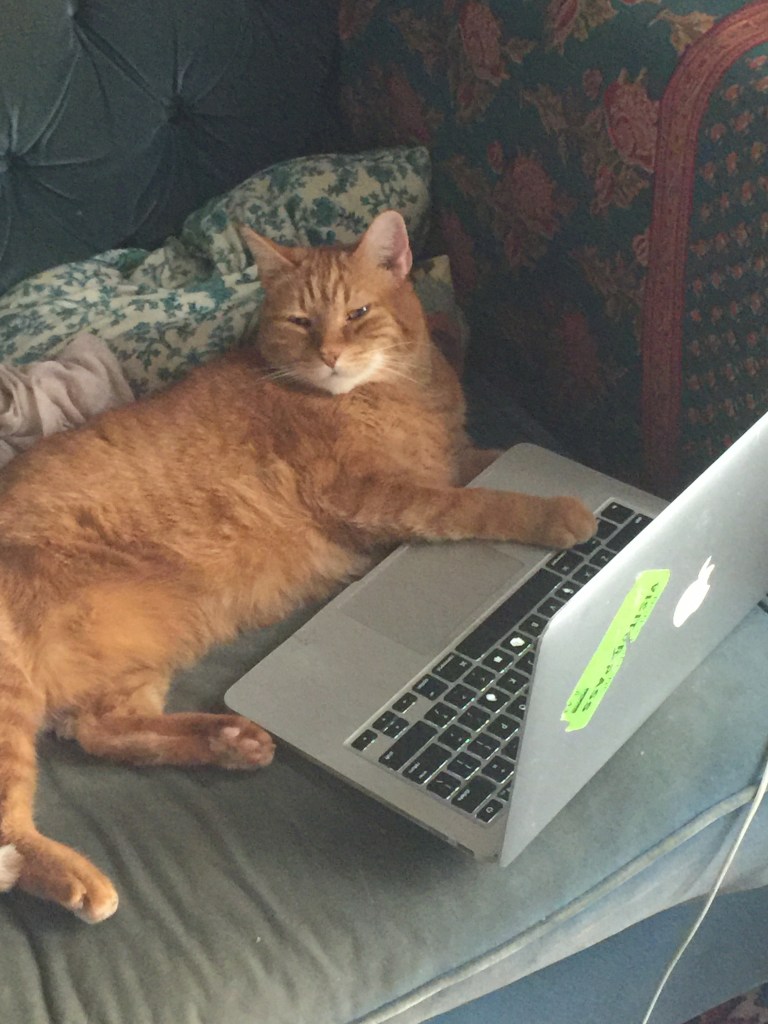
That is the cutest cat ever!!!
LikeLiked by 1 person
He knows it, too. He is indeed in my custody now, so MORE CAT PICS to come. Let’s see all the pets!
LikeLiked by 1 person
Sadly I have no pets ): only younger siblings boooo
LikeLike
That’s usually my situation too (although my younger sibling lives in Philadelphia, not underfoot…) so I’m very much enjoying the cat visit!
LikeLike
I noticed how now that technically I have more free time to sleep and relax, I’m actually doing less of it 😂
LikeLike
SO REAL.
LikeLike
Tommy looks like he is one good boi.
LikeLike
the best! (I mean, certainly the best for now, until he has competition.)
LikeLike
So something I discovered after our call on Thursday is this video:
and at minute 1:48 I’ve noticed that this is the exact same poem we just heard. Also, feel free to watch the whole thing I just wanted to share that 😂.
LikeLike
OMG love it. Yes it is. See, you just never know when these things will come in handy!
LikeLike
Another read worth following is this “quarantine journal” kept by writers & scholars: https://thepointmag.com/quarantine-journal/
LikeLike
I just finished reading “The Silence” and I almost broke down. The way he described his trauma; felt too relatable. Every word he uttered, I felt I was in his shoes and he was in mine. Not to say my experiences are the exact same, but they were similar. I couldn’t help but empathize his experiences. I appreciate that he was honest and forthright. I loved the story and its impact to me. Though our outcomes might be different, the lessons about moving forward in his story exemplifies the saying “whatever doesn’t kill you, makes you stronger.”
LikeLiked by 1 person
It’s a really, really moving piece.
I think one of the things that really sticks with me about it is the way silence offers trauma a place to grow. Diaz was a writer long before he was willing to write about his own trauma, of course, so maybe it’s a writer’s instinct to think about articulating things as a way of working through them—but other accounts of trauma, including by non-writers, share that aspect, often. It seems to me like there’s something about being able to articulate, name, describe that’s bound up in the ability to move forward. Does that seem right?
LikeLiked by 1 person
Yeah, it’s the ability to overcome adversity. I enjoyed the story because it didnt hold back any shots. You felt the pain, you felt the uncomfortable experiences, and you felt how it not only damaged him but shaped him.
LikeLike
The not holding back seems really important to me too. I wonder if the fact that you (and Michelle too, over in the other post) talk about feeling his experiences vicariously suggests something about the value of his articulating them—if “the silence” is about a refusal to speak, is it also a refusal to feel? This essay always makes me think that speaking and feeling go together in some way (although obviously he still feels a great deal when he’s unable to talk about or acknowledge his experiences).
LikeLike
It’s that part of us that feels ‘no one can understand what we’ve gone through”. I admire that he had the strength to say it and how all his stories were affected by his trauma.
LikeLike
Another little essay about silence and speaking out, by Audre Lorde (a CUNY alumna!): https://electricliterature.com/wp-content/uploads/2017/12/silenceintoaction.pdf
LikeLike
I’ll make sure to give it a read
LikeLike
Here’s a question I’m wondering about: what does it look like outside in your neighborhood?
I live in Sunset Park, Brooklyn, across the street from the park, on a residential avenue between two commercial strips. The coffee shop across the street is closed, but the bodega is still open, and there’s a little foot traffic coming and going to it. There’s also some foot traffic around the entrance to the park—families taking kids out to play for a bit, people walking their dogs, some folks running. It’s much quieter than usual. Some people wearing masks. Even car traffic is much less than on an average afternoon.
What do you see when you look out the window?
LikeLike
A lot of cars. I live in New Rochelle. People are cautious. Most the pharmaceutical and supermarket employees have gloves and mask. The cashiers maintain a yard distance. I had to drive the other to a Rite aid to get my father’s prescription; the cashier threw the prescription because of the distance between us. Some people are taking measures and finding ways to stay protected.
LikeLike