Poems for Thursday, March 12

Hey all. So take a minute. Imagine our classroom. And then imagine that class starts in the way it usually does: I’d ask you how the world is, and then I’d ask you how you’re reacting to our poems today. Answers to either question are welcome in the comments.

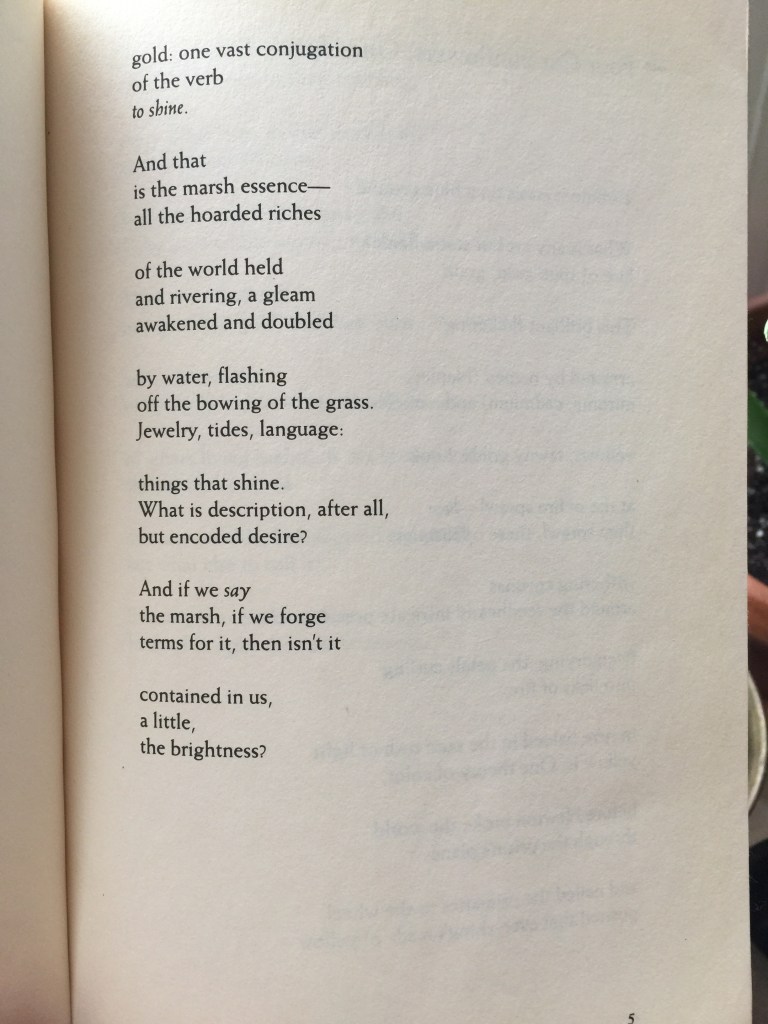
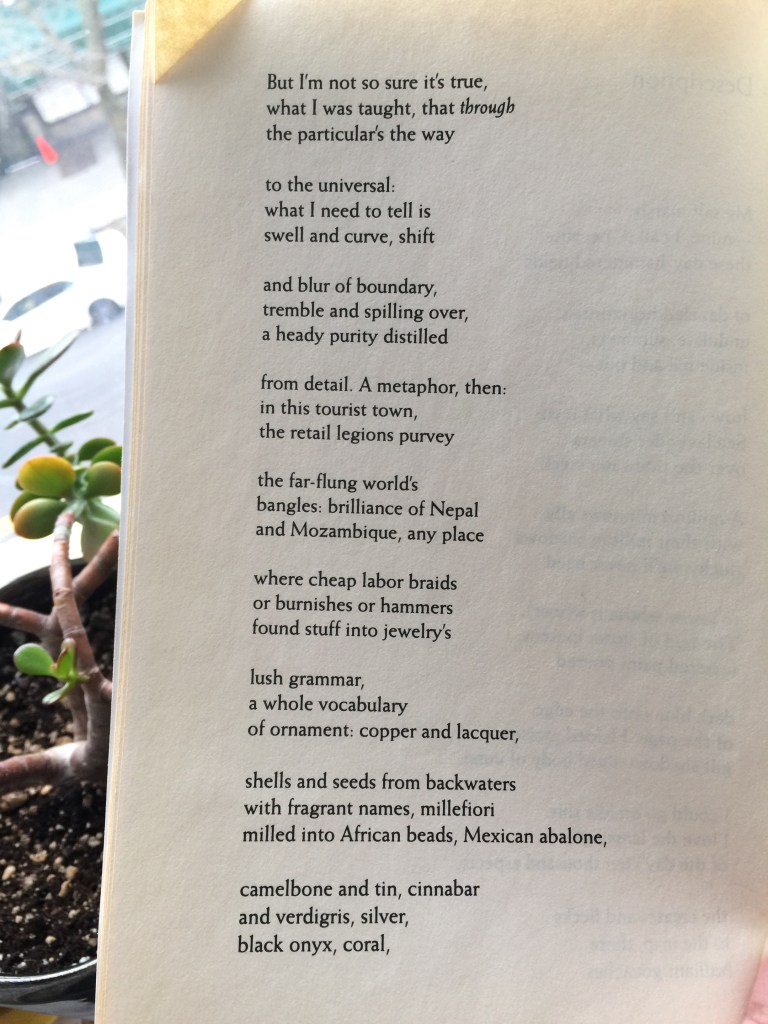
I’ll also offer a few prompts there more specifically. And here is the Mark Doty poem listed on our syllabus for distribution in class!

The short story #4

Even though there are societies with rules and regulations that may seem different than that from your own, at least the norms aren’t as odd as sacrificing someone for the greater good of that society. Or does that society actually exist, like imagine moving to an area for any reason and you walk into a place that’s really a nightmare wrapped in a pretty bow. In both “The Lottery” and “The Ones Who Walk Away From Omelas” that seems to be the case in fiction.

“The Lottery” starts off isolated and ordinary for all we know, then it later creeps into your curiosity of this traditional lottery that consists of everyone who participated. Now you might be thinking “what’s the possible award or outcome?”, and it’s so organized yet why is there this feeling of caution. Then you notice that the older generation is indirectly telling us how ridiculous this lottery is and how the rules have been changed yearly, and that the younger generation is clueless, just like how we’re somewhat clueless. Once the ending revealed that the whole act was a traditional sacrifice of one “lucky winner”, it’s still uncomfortable to realize that Tessie Hutchinson didn’t consider the lottery to be unfair, but the rules that made her end up being stoned was unfair. In other words, this evil act is normal in this society, which the story did a good job creating the suspense with the unusual atmosphere.

“The Ones Who Walk Away From Omelas” is sort of similar in it’s own sense of sacrifice. Basically you’re in a Utopian society that is way more sci-fi looking than your average society, and everything seems to be festive at first glance. But then you’re being informed that this society’s happiness is being fueled by the suffering of one child… so a cruel justice. There was no suspense to this one, it was mostly a flat out description saying how our normal society is complex compared to them saying how evil is interesting. And the more you hear the speaker talk about the child’s suffering the more absurd it sounds. But then once the people of Omelas grew up and gained a conscience, the ones who had a realization of this torture practice left Omelas to what can only be our normal society. Now at least in this society you have the option to leave, but I do wonder if it would have been a good idea to fight the system.

Both story’s societies can be viewed as the same when it comes to both societies being normal in the means of evil laws, yet they don’t share the same moral outlook. In “The Lottery” the moral could be simply to don’t blindly follow traditions only because a higher power says so. The impact that Tessie portrayed in the ending made that moral work since she didn’t think the Lottery was unfair, in fact mostly the younger generation didn’t think the lottery was bad in the slightest. Coming to the conclusion that “The Lottery” is mainly focused toward thinking for yourself when things seem odd for your own good. Now in “The Ones Who Walk Away From Omelas” you might say, well isn’t it the same for this story, technically but not mainly. The moral can possibly be similar in terms in your decision making based on your conscience. It is that you have the choice to have the child suffer or not, which is what the whole text was trying to make you decide. Either you help the child, change society and be hated by all, or be a part of a bystander effect and still feel bad for not helping. Sounds difficult, but at least we don’t live in a bad society, okay an even worse society.

#3 Short story

The lottery is my favorite short story we have read so far, i just find it really interesting how this story is basically death based on a lottery, so in a way you’re life is in your hands. I also find it really weird how the people throw rocks at the person who didn’t think it was fair, because i just couldn’t believe how many people were blinded by this tradition that they don’t feel sympathy for a person and even willing to kill them with rocks for thinking this tradition is unfair. I also feel like the oldest people in this village have all the authority over this tradition. And since they are in charge they also have the power to manipulate and not choose themselves for the sacrifice. Or maybe they even have the power to choose who they want to sacrifice. Maybe they already know who they want gone and they cover it up by calling it a lottery, but in reality it’s them who chooses but we will never know for sure if it’s true. Authority is very important because everything is controlled by them. And theres no way to actually know the truth about these lottery and if they even are “lotteries”. Everything basically depends on the authorities so it’s really an important part of the story. 

prompts: the play

So, Fairview was an exciting sprint for us in class—we had way more questions than answers about this complex work (including, at some point, the question of whether we needed a word other than “play” to categorize it!), and I’d encourage you to use your blog posts on the play to explore some of the lingering ones. A few suggestions:

  1. What is up with the textuality of this particular text? We talked a lot in class about what the physical space of a theater—the audience and the actors and the stage all in a relatively small space together—makes possible. But we also noticed that there are things in this text that won’t make it to the production of this text as a play—from the very first line, in which Beverley is described with the word “negro,” to the poetic lineation of the stage directions and some of their content. What do you see happening in those parts of the play’s text (what patterns do you observe, what moments stick out, etc.) and what do you think they mean?
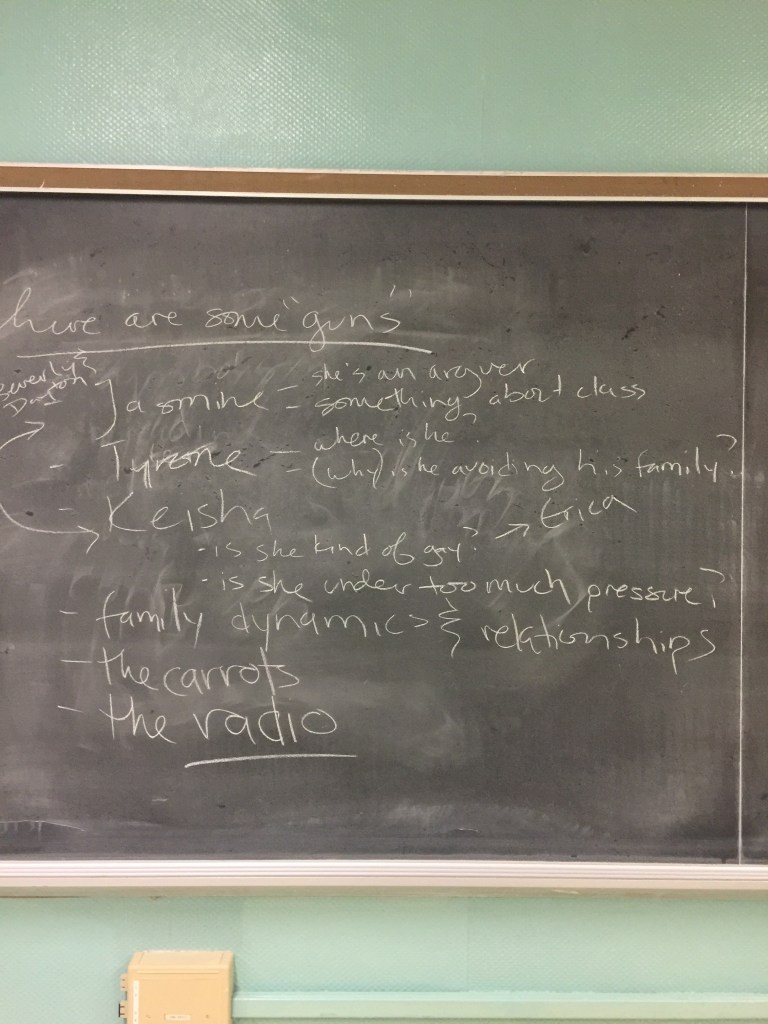
  2. The question of what’s real and what’s not seems important to this play. We discussed the carrots as the only “gun” that might actually go off, for example, when the interlopers bring in cartoonish fake food to cover up the family’s food, which the play tells us very specifically is real (“carrots, real carrots”). There is also the “pretend mirror hung on the fourth wall,” which suggested to us that while the mirror is pretend, the fourth wall is very real. Where else do you see this theme emerging, and what do you see happening when it does? (Or what do you make of either or both of these specific moments?)
  3. Our observation that the voices in the second act are unable to say that they don’t know felt really powerful to me. Did it to you too? Why or why not? What might that insight contribute to our understanding of the play or the dynamics it represents?
  4. Do we (do you/do you think the audience is supposed to) like Suze more than the other interloping white characters? Why or why not? What do you think that tells us about the play’s point of view?
  5. In class, we flagged the title of the play as relevant. What specifically do you think it suggest about what the play might be “saying” and/or how it works as a piece of theater?
  6. Finally, a question about the play as a form or genre. As I mentioned in class, the reason I chose to assign this play instead of a more conventionally narrative one is that I think its formal focus makes visible some things about how plays work that more conventionally narrative plays rely on but tend to hide. What elements of the structure of the play as a form become visible in Fairview? Can we apply them to other plays, or even other kinds of forms? (How?) Put another way, next time you read or see a play, will you see it differently because of Fairview? Why or why not? In what ways, if so?

prompts: the short story

As we start the writing phase of this project, there’s still time to reflect back on the short stories we’ve read—and we’ll also want to do some thinking about what we learned about the form. So here are a few questions you might want to take up about our texts, their relationships, and our sense of the genre category they represent.

  1. In class, one major question we had about “The Cheater’s Guide To Love” was about the relationship between the protagonist and the narrator—both in this particular story and in general. What do we notice about that relationship in “The Cheater’s Guide To Love,” and what does it point out to us about short stories?
  2. We puzzled over the question of “abolishing Hades” that comes up at the end of “The Diamond As Big As The Ritz.” What’s going on with Hades in that story? What effect does it have on the tone of the story? What role does it play in the ending?
  3. When we discussed “The Lottery,” we considered the question of who—if anyone—is really in charge in the village. Some of us argued that the people (men) in charge of the ritual are in a position to manipulate its outcomes to their own advantage, and that’s potentially true (even if the story doesn’t show that happening), but it’s still true that even they don’t always get their way. How do you think this story distributes power or authority? Why is that important?
  4. Both “The Lottery” and “The Ones Who Walk Away From Omelas” describe societies deeply intertwined with an act of sacrifice. What’s consistent between them about the societies they represent, the central act of sacrifice, and their ways of depicting those things? What’s not? Are both stories metaphors for the same society or societies? Do they share a moral outlook, or do they have different messages?
  5. In “The Ones Who Walk Away From Omelas,” some people decide that they can’t accept the bargain that continuing to live in their utopian society demands, and they walk away. But none of them intervenes—and the story itself doesn’t point that out to us. Does that change our sense of the story’s moral argument, if we think it has one? And does it change our sense of the story as a moral authority?
  6. Those two stories were grouped in a week called “Stories of Societies.” Are there any of our stories so far that couldn’t plausibly be put in that category? Why or why not? And does that mean anything about the short story as a form?
  7. What’s up with the fascination with stories in “The Husband Stitch”? We were intrigued and puzzled by Machado’s references and relationship to stories, including the directions that the story gives for reading it out loud—this was a question we flagged in class for more thought. How does this story treat other stories? What do we notice about the role they play? Are they the same kinds of story as the one we’re reading, or something different?
  8. When we talked about trying to define literature early in the semester, one thing we considered that it might need is plot. How much plot does a short story need? “What We Talk About When We Talk About Love” spans only a couple of hours, and all that happens is that four people sit around a table and drink a bottle of gin and talk. “The Diamond As Big As The Ritz,” by contrast, features an action-adventure plot full of big events. Is there a minimum? How might we define plot? What role does it play in the short story as a form or genre?

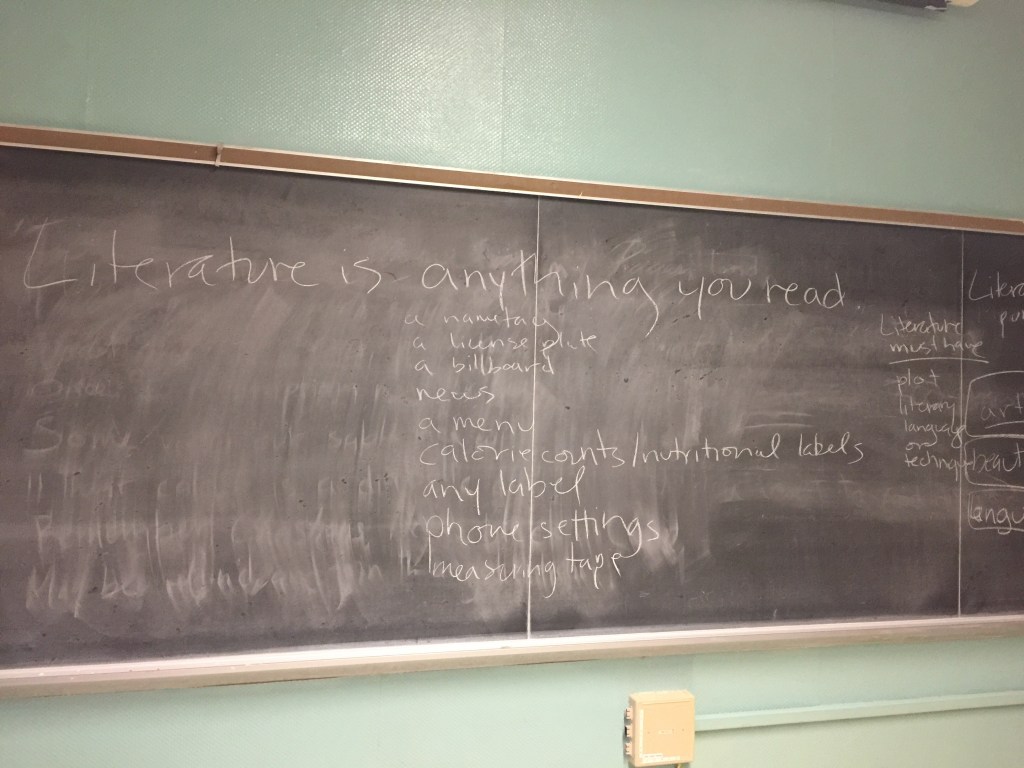
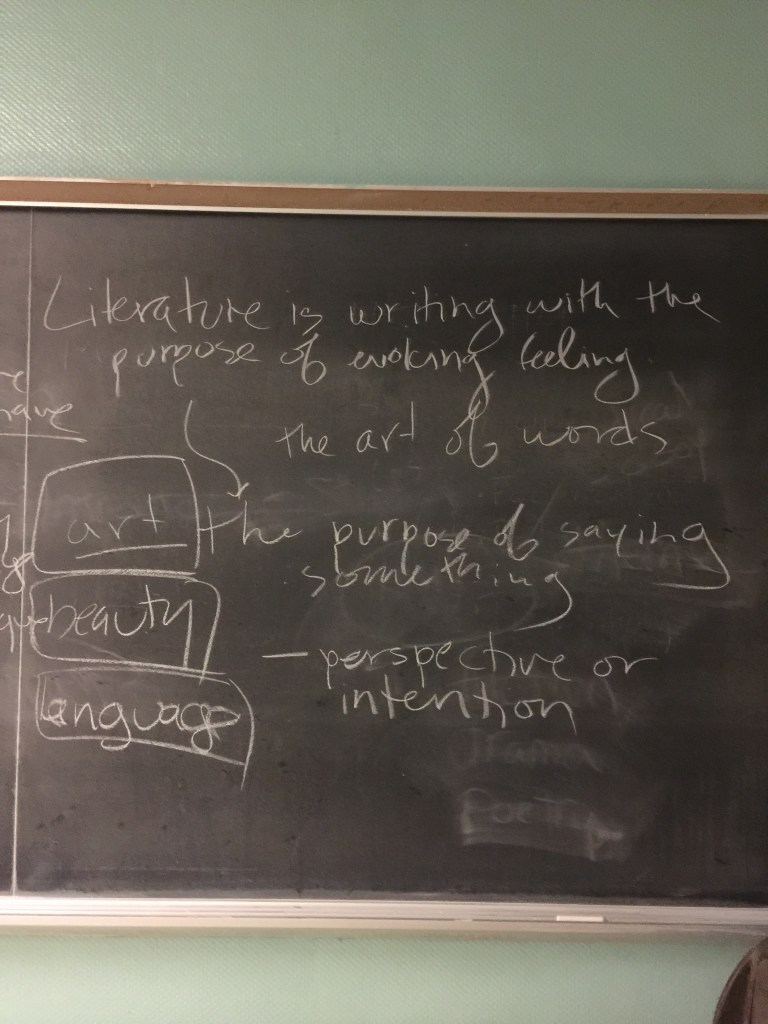
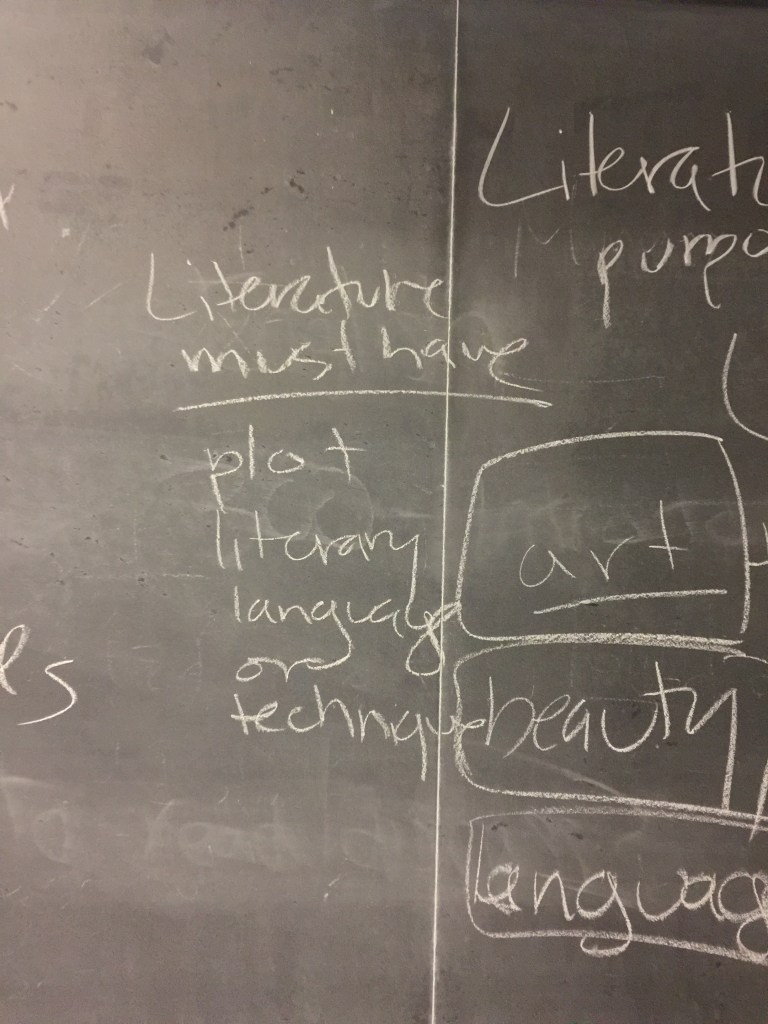
“I just wanted an answer and all I got was more questions”: notes from our valiant attempt to define literature

Then we tried to rule out the examples we wanted to exclude from our definition of literature…
Those Big Concepts on the left kept coming up for us as related to our attempt to define literature.
This little list reflected an attempt to figure out what we expect of literature, whether accurately or not.

how to use this space

  1. Read and comment on your classmates’ posts. As you’ll have noticed in class, there’s so much more to talk about than we can cover in class! This space can be a place to open up some of those conversations.
  2. Post your own thoughts! This blog is an extension of our class discussions, and it’s also a chance for you to take the time to think an idea all the way through. The format also introduces the possibility of bringing in outside resources: research, for example, that might help you contextualize our texts or offer perspectives with which to think through them; or web-based material (videos, songs, memes, etc.) that might inform our thinking & that you can link to or embed here (check out the + button at the top left of the post editor).
  3. Check the prompts if you’re feeling a little stuck. Watch this space for evergreen and week-by-week prompts.
  4. Don’t forget to categorize and tag your posts. One of the things the blog platform can do for us is give us the chance to consider the way things connect to each other. For that reason (and also to make all of our lives easier when we revisit our archive as we create our final project), don’t forget to use the category and tag features when you post! The category should be the genre unit—the short story, the poem, etc. But I encourage you to get creative with your tags—you can add as many as you like! Consider using the author’s name, a word or phrase that references a major idea, etc. So for example, a post on “The Diamond As Big As The Ritz” would be categorized with “the short story,” but could feature tags like “F Scott Fitzgerald”, “close reading”, “historical context”, “abolishing Hades”, “religion”, “dehumanization”, and so on. There’s no limit. (Those tools are in the “documents” tab of the editing tool when you’re posting.)

Welcome to literarygenres.blog!

Hi all,

This is our course blogging space! As we’ve discussed in class (& on the syllabus, etc.), you are responsible for five blog posts here over the course of the semester. As we settle in here, I’m going to be posting prompts that refer back to the units that we’ve already done (short story, play) and as we progress through the semester I’ll be posting weekly prompts.

I’m looking forward to seeing what we create together!

Best,

Mollie