Severance

“To live in a city is to live the life that it was built for, to adapt to its schedule and rhythms, to move within the transit layout made for you during the morning and evening rush, winding through the crowds of fellow commuters. To live in a city is to consume its offerings. To eat at its restaurants. To drink at its bars. To shop at its stores. To pay its sales taxes. To give a dollar to its homeless.
To live in a city is to take part in and to propagate its impossible systems. To wake up. To go to work in the morning. It is also to take pleasure in those systems because, otherwise, who could repeat the same routines, year in, year out?”

This quote from the book really stayed in my head because I feel like it describes what life in the city essentially is and the kind of people that it takes to live in a concrete jungle. Especially in the city that never sleeps. Where even if you stop moving, nothing around you ceases or pauses. Adaptability is what defines city folk as we have to adapt to disruptions in commute, while we’re in transit, in our sleep and work. Not a single aspect of our lives is unaffected daily.

-Rachel

Remember Fairview? (Under Surveillance) (My perspective)

When many of you think of plays you think of the many books that are written by Shakespeare. When you think of plays you think of drama, or a comedy even. Those are the necessary subgenres that categorizes in a play. But in Fairview, it seems to be more than your average family drama, and more of a surprise. 

The first thing they kept consistent was the suspense, the possible triggers that could potentially set off at any moment in the play. You see, this is normal in order to keep the audience interested, in this case there were many things in Fairview that looked obvious. From Act 1 there were the props, the fake carrot, the “nervous” glitchy radio, the fourth wall breaking through the pretend mirror, the characters suspicions/conspiracies. Not only did the play keep its suspense, but it also kept elements of what a play should have like foreshadowing, the goal of accomplishing a perfect family dinner which could go horribly wrong. 

But then there was Act 2, where the scene changes to another play where the (white) people in Act 2 are watching the (black) people in Act 1, and there’s a lot of stereotyping going on. The play purposefully played with the audience interest and decided to make them feel understandably uncomfortable, as if they know their audience. That’s all it was until you go to Act 3, where none of the triggers from Act 1 set off, making you think “what was the point of ‘that’ then?” It was then you realize that the play was a setup from Act 1, the inability to see the real story, to tell the story to everyone and not just a specific audience. Bringing out the guilt of the racists, exposed in a fairview.

Regardless what subgenre this could be viewed to you, it’s a play nonetheless. And story writing like this can prove the great lengths a play can go. They got us in the first half, but it still made sense to why they did it. Because according to the article, “How can watching theater benefit the mind?”, it states that “Watching a play also allows the audience to access emotions they often don’t.” So it’s like how we watch shows for the sake of escaping reality. Taking that into consideration, we can say that Fairview did set us up to witness something we weren’t prepared for, only to make you cringe between the lines. In other words a play can be meant to bring realism, you just need to be ready for the backlash. All in all, Fairview did a good job giving a twist to plays.

Proposing Final Projects

Hey all,

Belatedly, here is a thread for proposing final projects! As we discussed on our call, we like this platform & we want to see each other’s proposals—so post yours in the comments. It’s an informal piece of writing, and you can think of it like thinking out loud. The goal is just to give yourself a chance to think through the project you’d like to spend some time and effort on, and make some plans to get you started.

Your proposals are due April 27.

Your final projects are due May 21.

the goals of this project

The primary goal of this project is to give yourself a chance to consider some of the important issues of our course in ways that feel like they also offer you the chance to pursue your own intellectual interests. I want you to have a lot of freedom here to do something that sounds good to you, and you should think about this project as a use of your time. What feels interesting, valuable, and sustaining to you right now? You might think about how you could connect

Your project should help you spend some time with the issues we’ve raised as the basic theoretical architecture of our course, and your proposal should explain how the project you’re proposing accomplishes that.

Your project can be done alone or with a classmate or classmates. It can be experiential (run and conduct a virtual book club with friends/family/classmates, develop and document a daily reading practice of your own, etc.—something you do that’s related to our work in class this semester), creative (a personal essay about any of the issues that have come up in our readings and discussions, an Instagram art project inspired by one of our texts or theoretical issues, a vlog series or podcast, a game, etc.), or analytical (a collaborative critical conversation with classmates documented in a form of your choosing, an essay taking up any of the ideas that have come up for you during this course, etc.). [There are more traditional essay prompts at the bottom of this post, if they’d help you get started, but feel free to propose your own—if you do, you might think about what audience you’re hoping to reach and use this as an opportunity to write for that audience—if you’d like to think about writing something you could submit for publication, I’d be more than happy to help.]

the proposal

The goal of the proposal is to do some foundational thinking for your project. Think about it like thinking out loud and thinking through, rather than as a polished formal piece of writing.

Your proposal should address the following questions:

  • What form will your project take? What do you plan to do, and what do you plan to turn in?
  • What are the motivating questions, interests, and goals of your project?
  • How does your project relate to our course?
  • Would you welcome collaboration from a classmate or classmates? (Group projects are totally okay!)

If you do a creative or experiential project, I’m also going to ask you for a critical or analytical statement to go with it. That statement should be 2-3 pages long, and it should provide some perspective on your project—what you hoped it would do, how it went, and how it relates to the issues of our course.

some questions to get you thinking

What would happen if you wrote about the same idea in more than one form?

How does literary genre pop up in our day-to-day lives?

What kinds of things defy genre categorization?

the essay option

If you would like to write an essay to conclude the semester, I’m happy to oblige. Below are three prompts. Your essay should be 5-8 pages long, and it should field your own individual answer to one of the following prompts and your reasoning for that answer. It should also make reference to at least one text and genre that we’ve read this semester, If you choose the essay option, your proposal is a chance to explain which prompt you’ll be responding to, why that prompt interests you, and where you’re going to take that prompt (topic, texts, etc.).

  1. Choosing one of the genres we’ve considered in class, and at least one example of that genre to use as an example, think about what a “genre” is. How does it affect the way we read and interpret a text? What information does it provide? What can you see about the particular genre and example of it that you’re addressing, and what do those observations lead you to think about genre as a categorical structure?
  2. Using the tools we’ve developed in class, consider a literary form we haven’t studied. What are its most important formal features and considerations? How does its form matter to the experience of reading it or the practice of interpreting it? Use a particular text from the genre you’re choosing as an example.
  3. We also use the word “genre” to designate categories of subject matter: romance/sci-fi/fantasy/crime/etc. Choose a genre of this kind, and, using the tools we’ve developed in class for thinking through , develop an argument about its parameters. What must something have to fit into that genre? What can’t it have? What are the most important formal elements of the genre? How does this sense of “genre” relate to “genre” in the sense we’ve primarily used it this semester?

I can’t wait to see what you come up with!
Choosing Our Novel: the options (plus, pitch your own!)

Hi all,

So, it’s (past) time to choose the novel that we’ll read together for the remaining weeks of class, while you work on your final projects. I’m pitching four here, and I encourage you to add your own pitches in the comments! On Thursday when class starts, we’ll take a vote & launch our discussion.

Severance, Ling Ma

This is a pandemic novel, which satisfies our desire for something that’s relevant to our current moment. It’s also a pandemic novel set in New York, and it imagines how life breaks down in the city under pandemic conditions in ways that we could both measure against the reality we’re now seeing outside our windows and also might find helpful as a place to think through the things we’re experiencing.

You can read a little more about the novel here—this might make you want to read it (it made me want to read it!).

The Road, Cormac McCarthy

This is the postapocalyptic novel that came to mind when we talked about wanting a postapocalyptic novel on our call.It’s not a pandemic novel—the event that precedes the events of the novel is an instantaneous one. The novel itself follows a survivor seeking safety (very different than Ma’s depiction of a city in the midst of the pandemic!), and it’s written in McCarthy’s characteristically very spare prose. He’s an established major American novelist, and this novel was also adapted into a movie, I believe (which would give us grist for formal interpretation).

This is How You Lose Her, Junot Diaz

We’ve read Diaz in the short story and the essay, and he’s made a strong impression in both forms/genres. We could also try him in the novel—well, sort of. This is How You Lose Her is a novel in short stories, a set of separate but interconnected narratives dealing with the lives and events we’ve already had a glimpse of in “The Cheater’s Guide to Love.” Yunior appears often, of course, usually but not always as narrator, and we also learn more about the other characters we’ve met or heard about in that story. Diaz’s voice and the continuity that this offers might be enjoyable and interesting to us (especially right now)

Mrs. Dalloway, Virginia Woolf

The title character of this landmark novel by Virginia Woolf is a survivor of the 1918 flu pandemic. The novel itself focuses on an ordinary day in London, the life of the city both as it’s shaped by world events (the legacies of the flu and World War One, political events at the national level) and by the vividly drawn interior and social lives of the interconnected characters. Woolf is a hugely influential novelist, and Mrs. Dalloway is a hugely influential novel—once you read it, you’ll start seeing how many references there are to it. In particular, she’s an innovator in style, and while her lush, intense sentences can be complex, they also might be both really pleasurable and deeply rewarding right now.

Want to pitch something else? Chime in down below in the comments!

Ready to vote? Go here!

Essay

When we think about essays what we usually think is New Times Roman, font size 12, double space, pages 2 or 4 (sometimes more) and the topic we must discuss, compare, and analyze; Essay have traditionally been classified as formal or informal. I personally believe writing essays is a good way to exercise your ideas, spelling, and using vocabulary, the problem is getting your ideas in paper because speaking English is easy our sub-conscience knows when to stop, pause, and add a sentence but not writing it down can be tricky.

the essay: “I” and “we”

Here are the essays we’ll be discussing this week on the blog and in our Thursday Zoom call. I’m assigning two pairs of essays, which each operate in some kind of relation to each other. If your time is limited this week, I suggest that you read one pair.

pair 1: interdependence and independence

Briallen Hopper, “Lean On”

This seems timely to me—it’s an essay that considers the value of human interdependence, using literary readings along the way to consider where our ideas about what we should need from and depend on each other for come from.

And here’s an exciting piece of news to go with it: Dr. Hopper, who teaches creative nonfiction writing at Queens College (and has previously taught at Yale after earning her PhD from Princeton) will join us for our Thursday Zoom call—if we get lucky, she maaaaay even be stopping by this post to respond to your thoughts, so feel free to ask questions in the comments that would benefit from her input.

Joan Didion, “On Self-Respect”

Joan Didion is one of America’s great essayists. This little piece from 1961 was originally published in Vogue magazine (there used to be literature in fashion magazines…just as there used to be serious fiction and interviews in Playboy! Times have changed), and it reminds me of “Invictus,” which I read you on our call last week. It might still feel timely to us and to contemporary debates about the idea of “character,” its contents, its contexts, and its absences.

pair 2: education, personal and political

Mary McCarthy, “Getting an Education—I”

Mary McCarthy was a critic and a novelist, and she also wrote a memoir about her Catholic girlhood. This essay reflects on the role of education in her early life—what it meant to her, how it related and diverged from school—in the first person, which might be an interesting chance to consider how we reflect on and value our own education(s). She thinks about education with political resonance, but primarily as a personal experience, which is a little different than the alignment of elements in the next essay…

Vinson Cunningham, “Prep For Prep and the Faultlines in New York’s Schools”

This essay might make you feel angry, and it might make you feel sad. It makes me feel both of those ways. It’s also a different kind of essay than the others we’re reading for the week: it leans more heavily on reporting, on the kind of argumentative structure and evidence that might feel familiar to us from people trying to teach us how to write essays for school. As you read it, try to pay attention to the ways that it fits into and departs from that model.

hangout post the first

Welcome to our first off-topic on-purpose post.

I think it’s feeling important to all of us to stay connected right now, and this is a place where we can do that. I’m still (as I’ve already said several times by now!) sad and mad about the loss of our classroom, but there are some ways that we can keep building a space together, and this is one of them. I also remain really interested in what the record of this time in American life will look like, and this might be a place to feel like we’re contributing to it—and as was mentioned in our Zoom call yesterday, times of chaos can also be times of change and possibility. What might we make together?

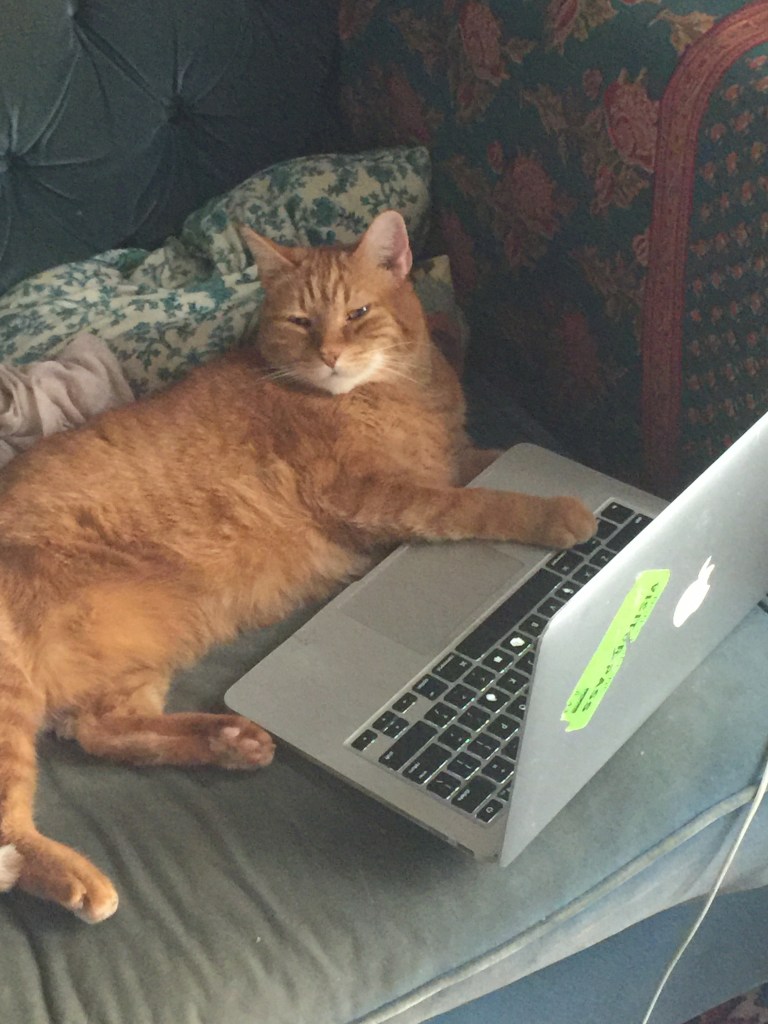
This extremely photogenic fella does not belong to me, but if the friend to whom he does belong clears out of the city, he is coming back to my place & if that happens I can promise quality cat content. His name is Tommy. Tommy loves you even though he’s never met you.

Here’s something I’ve been reading that feels sustaining to me, even though it also taxes the limits of my currently-distracted intellect: “I don’t know how to live without doing research,” says the fascinating scholar behind the origin of the Afrofuturism movement in an interview.

10/10 the creepiest thing I’ve seen all week.

A first-person reflection on how art & culture can get us through tough times, with a movie recommendation.

A really fluffy sheep.

weekend prep questions: the essay

So, most of us probably think of “an essay” as something we write for school. (If I’m wrong, please tell me so in the comments!) The essays we’re going to read for our essay unit, though, aren’t quite that kind of essay. (If you’d like examples of academic essays that I think are particularly impressive, I’d be happy to provide—please let me know, because academic writing can be quite beautiful and quite ambitious as well as correctly scholarly, and knowing that might help us think about what we’re trying to do when we do write essays for school.)

So…what IS an essay, exactly? Remember when we tried to define some of our big terms at the beginning of the semester? As we prepare to read some essays over the next two weeks, let’s think about some similar questions. Take a few minutes (no googling!) to think about how you’d define the parameters of an essay, and try to articulate your answer to that question in the comments.

What is an essay? How do we know that a piece of writing counts as one? What’s the point of an essay—what is it trying to do? What features must it have? What features CAN’T it have? How is reading one different from reading a short story, or a poem, or a play?

You don’t have to answer all those questions, but they’re there to get you thinking.

As a possible prompt to your thinking: remember the way we talked about “The Cheater’s Guide to Love” and how we’d respond differently to it if it were an essay and not a story? For us, that seemed to have a lot to do with how we related to the narrator (we liked hanging out with Yunior, even though we also pretty uniformly agreed he was an asshole). It even came up specifically that there might be a different relationship between a reader and a narrator and a reader and an author, and that the “narrator” of an essay might be the author and not a character, and that might alter the way we think of the ideas in a piece. We also imagined the possible differences to a version in which the author was trying to offer a real explanation for his behavior, which we didn’t really get in “The Cheater’s Guide to Love.” Well, interestingly, there’s an essay that’s a kind of a companion piece to that story that does pretty much exactly that—Diaz’s 2018 “The Silence: The Legacy of Childhood Trauma.” It’s a really good essay, but do be warned it’s also a tough read in spots, which you may not need in your weekend. Check your gut (taking good care of ourselves is important right now!). But it’s a powerful read, and it offers an impressively direct comparison across genres, which is good food for thought.